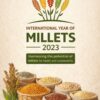
Millets are well known for their ability to grow in dry regions, require fewer resources, and withstand changing climate conditions. These qualities make them an important crop for improving food self-sufficiency and reducing dependence on imported grains. Recognizing their value in strengthening food security and climate resilience, the United Nations General Assembly declared 2023 as the International Year of Millets (IYM 2023).
To support this global focus, international organizations have stepped up efforts to promote awareness, research, and innovation around millets. While the Food and Agriculture Organization (FAO) led initiatives to highlight the nutritional and environmental benefits of millets, the International Atomic Energy Agency (IAEA) also continued investing in scientific research through its collaboration with FAO under the Joint FAO/IAEA Centre of Nuclear Techniques in Food and Agriculture.
The momentum created by IYM 2023 has encouraged increased research funding, policy attention, and development across the entire millet value chain. As part of this effort, the Joint FAO/IAEA Centre launched a Coordinated Research Project (CRP) focused on accelerating the genetic improvement of major dryland millets to help them adapt to climate change. The project aims to develop improved varieties of pearl millet, finger millet, foxtail millet, and proso millet using modern breeding techniques such as mutation breeding, genomics, and gene-editing tools.
These efforts align with global priorities to strengthen farming systems by diversifying crops beyond a limited number of staple cereals. By improving resilience against environmental challenges and economic uncertainties, enhanced millet varieties can play a key role in supporting nutrition and livelihoods, particularly in vulnerable regions.
Now in its second year, the research initiative has brought together a strong international network of scientists and institutions from countries including India, China, Ethiopia, Sri Lanka, Burkina Faso, Namibia, and the United States. FAO’s Plant Production and Protection Division is also actively involved, especially in identifying country-specific challenges across the millet value chain.
In April 2025, researchers involved in the project met in Vienna, Austria, to review progress and plan future activities. The meeting enabled scientists to share early findings, exchange expertise, and align research strategies. Key discussions focused on using digital phenotyping tools, combining genomics with advanced breeding methods, and speeding up the development of improved millet varieties. Improving resistance to pests, diseases, and climate stress—while also enhancing nutritional value—was a major priority.
The advanced laboratories of the Joint FAO/IAEA Centre in Seibersdorf were highlighted as a critical resource, particularly for researchers from developing countries, enabling large-scale screening of newly developed millet lines.
This global research initiative is not only advancing scientific knowledge but also strengthening national research capabilities and supporting smallholder farmers. By promoting adaptable, high-performing, and climate-resilient millet varieties, the project demonstrates how international cooperation, innovation, and capacity building can drive long-term sustainability in the millet sector—contributing to resilient food systems for future generations.
Reference:
This article is inspired by publicly available information from the Food and Agriculture Organization of the United Nations (FAO) and the International Atomic Energy Agency (IAEA).